Sep 21 ‘26
38 min read
No time to read? Get a quick AI summary
In October 2024, Progress Software completed its $875 million acquisition of ShareFile from Cloud Software Group — the third ownership change for the platform in roughly three years. For many ShareFile customers, that moment became a tipping point. Questions about the long-term roadmap, pricing direction, and product focus pushed a growing number of teams to ask: “What are some alternatives to Citrix ShareFile that can replace it in M&A, due diligence, and professional services workflows?”
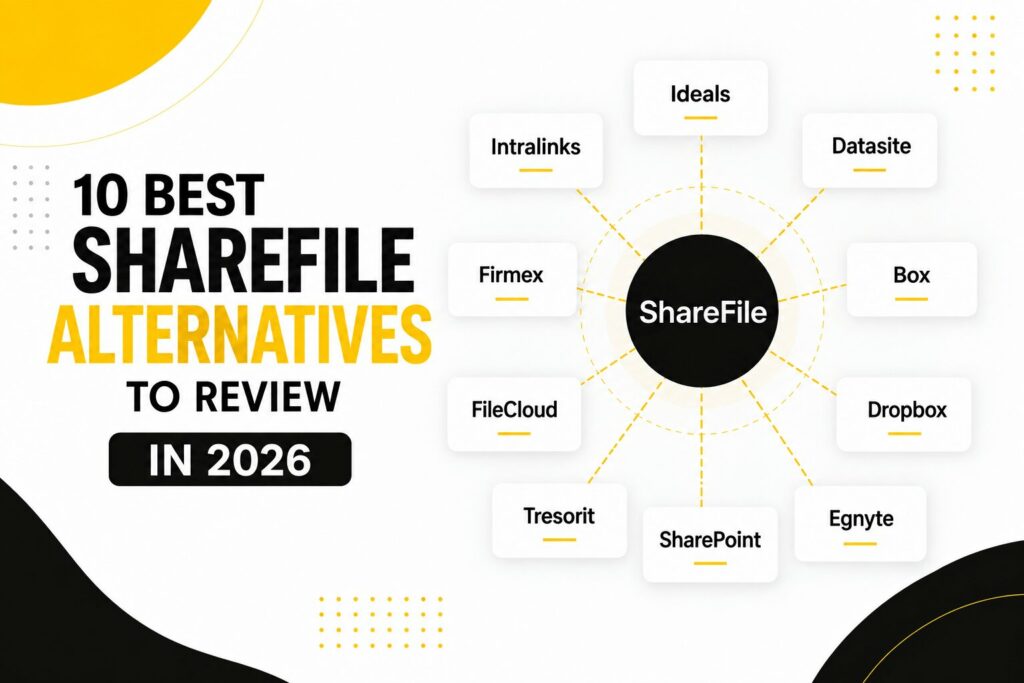
This article compares the 10 best ShareFile alternatives, covering virtual data rooms, enterprise file-sharing platforms, and secure collaboration tools, so deal teams, accounting firms, and IT buyers can pick the right replacement for their specific business needs.
- A note on naming: ShareFile is no longer owned by Citrix. It passed from Citrix to Cloud Software Group in 2022, and then to Progress Software in October 2024. However, many users and search queries still refer to it as “Citrix ShareFile” — a legacy of its decade under Citrix ownership. Throughout this article, we use both “ShareFile” and “Citrix ShareFile” to reflect how the platform is commonly searched and discussed, not to imply any current affiliation with Citrix.
Why Consider ShareFile Alternatives?
ShareFile handles the basics well: secure remote access and remote file access from any device, branded client portals, audit trails, and compliance certifications. However, there are some issues that make users consider Progress ShareFile alternatives:
- Per-user pricing scales painfully. ShareFile charges per user per month across all tiers. Some users report unexpected mid-contract changes, including a policy requiring everyone on a company domain to hold a paid license.
- Three ownership changes in three years. Going from Citrix to Cloud Software Group to Progress Software in quick succession raises genuine questions about product continuity and roadmap alignment.
- Dated interface. Multiple verified G2 reviewers describe the UI as clunky and slow. They also state that the interface is confusing, especially for new users, making navigation less intuitive.
- Sync and performance issues. Some reviewers report synchronization and performance issues. One Capterra reviewer stated that ShareFile “does not sync across devices and users” consistently and sometimes requires files to be saved under a different name or location before changes become visible. The same reviewer reported slow indexing in Windows environments, while Capterra’s review summaries highlight recurring complaints about slow uploads, lag, and performance issues during large file transfers.
- VDR features feel bolted on. Unlike ShareFile, dedicated virtual data room providers offer more deal-focused VDR features, especially regarding data security. A TrustRadius reviewer stated directly: “ShareFile is not as appropriate or user-friendly to utilize as a data room for an M&A transaction because it does not have as many tools as other options.”
Read more: Explore all the facts about ShareFile in the dedicated ShareFile review.
10 Best Alternatives to ShareFile in 2026
Now, let’s take a look at what ShareFile alternatives users consider in different situations.
1. Ideals VDR
Ideals is a purpose-built virtual data room rated a G2 Market Leader for four consecutive years. Since 2008, the platform has focused on high-stakes document sharing — M&A transactions, fundraising, due diligence, and regulated deal workflows. Ideals includes fence view (preventing screenshots), dynamic watermarking that persists regardless of download settings, eight levels of granular permissions, full-text search, Q&A management, and detailed activity dashboards. Certified to SOC 1/2/3, ISO 27001, HIPAA, and GDPR. 24/7 support in 10+ languages with sub-30-second live chat response times.
Pricing is storage-based across three tiers (Core, Premier, Enterprise), which is predictable for teams.
- Strengths: Purpose-built VDR features, four-year G2 leader streak, fence view and dynamic watermarking, exceptional 24/7 support, storage-based pricing
- Drawbacks: Pricing might not be suitable for smaller teams
- Best for: M&A, due diligence, fundraising, investment banking, private equity, and regulated transactions
Read more: Explore the full selection of top virtual data room providers on our main page.
2. Datasite
Datasite (formerly Merrill Corporation) is the enterprise standard for large-cap M&A, IPO preparation, and complex cross-border transactions. The platform handles 55,000+ deals annually. Key differentiators include AI-powered tools such as bulk redaction, document summarization, automatic categorization, and translation, as well as the industry’s first ISO 42001 AI governance certification. Pricing is custom and, according to some third-party resources, per-page based, making it one of the most expensive options — smaller teams often find it hard to justify for mid-market deals.
- Strengths: Enterprise AI tools, comprehensive compliance (ISO 27001, SOC 2, ISO 42001)
- Drawbacks: Expensive per-page pricing, learning curve for new users, not cost-effective for smaller deals
- Best for: Large-cap M&A, IPO preparation, Fortune 500 corporate development
3. Intralinks (SS&C)
Intralinks has been a fixture in financial services M&A for over 25 years. VDRPro, its flagship product, includes automated indexing, AI redaction, advanced Q&A, watermarking, and a one-click document retraction (Unshare) feature built on information rights management. The platform was one of the first VDRs to earn ISO 27701 certification — the highest available privacy standard — alongside GDPR, HIPAA, and SOC 2 Type II. Pricing is custom enterprise-grade; some users note hidden costs that inflate final invoices beyond initial quotes.
- Strengths: 25+ years of deal track record, ISO 27701, IRM, and Unshare feature, trusted by Fortune 1000
- Drawbacks: Expensive for smaller deals, limited pricing transparency
- Best for: Investment banking, large M&A, cross-border transactions, alternative investments
4. Firmex
Firmex is a mid-market VDR founded in 2006 and used primarily for M&A due diligence, legal transactions, and project financing. Its Q&A module is one of the strongest in the segment, with role-based question routing and per-bidder scoping. Both a per-transaction pricing model and an unlimited annual subscription are available — the latter is valuable for advisory firms running multiple concurrent mandates. SOC 2 Type II, GDPR, and HIPAA compliant. G2 and Capterra ratings: 4.7/5.
- Strengths: Mature Q&A workflow, unlimited-user pricing on all plans, 24/7 support, predictable economics
- Drawbacks: No public pricing, no page-level analytics (file-level only), per-project pricing is less ideal for ongoing workflows
- Best for: Mid-market M&A, legal due diligence, advisory firms, project financing
5. Box
Box is an enterprise content cloud used by over 100,000 businesses. It is not a purpose-built VDR, but for organizations that need a broad, secure file-sharing solution with an exceptional compliance and integration footprint, it is a strong option. Users can easily access files and receive large files from clients, with secure remote access available on any device through a web browser or desktop app. Box holds SOC 1/2/3, HIPAA/HITECH, FINRA/SEC 17a-4, ISO 27001, FedRAMP High, and GDPR certifications. It integrates with 1,500+ applications, including Microsoft 365 and Salesforce. Business plans start at $15/user/month; HIPAA compliance requires higher-tier plans. Box lacks deal-specific features like fence view, dynamic per-viewer watermarking, and structured Q&A.
- Strengths: Exceptional compliance certifications, 1,500+ integrations, Box AI, FedRAMP High
- Drawbacks: Not a purpose-built VDR, advanced compliance features gated behind higher-tier plans
- Best for: Enterprise content management, healthcare, and financial services, FedRAMP-required environments
Read more: For a full feature breakdown, see ShareFile vs. Box.
6. Dropbox Business
Dropbox is one of the most widely used cloud storage and file-sharing platforms globally. It lets users share files easily via expiring links, access files through any web browser or desktop app, and sync reliably across multiple devices. Password protection, expiration dates on shared links, and granular folder permissions are all included. SOC 2, ISO 27001, and GDPR compliant. Business plans start at around $15/user/month.
Dropbox has no dedicated VDR tier or structured Q&A. It is best for straightforward client file exchange and general team collaboration — not for regulated deal workflows.
- Strengths: Excellent sync across multiple devices, clean UX, broad app integrations, competitive entry pricing
- Drawbacks: Limited compliance depth without premium plans, no VDR-specific features, pricing criticized as expensive versus Google Drive and OneDrive
- Best for: Small teams, creative workflows, general file sharing
Read more: Explore the detailed ShareFile vs. Dropbox comparison to know how both providers differ in terms of features, pricing, and use cases.
7. Egnyte
Egnyte is a hybrid content security and governance platform with particular strength in AEC, life sciences, and healthcare. Unlike ShareFile and most cloud storage tools, Egnyte can manage files simultaneously on-premises and in the cloud — which matters for organizations with data residency requirements. Key features include AI content classification, ransomware detection with automatic file recovery, and data loss prevention. GDPR, HIPAA, and SOC 2 compliant. Business plans start at $22/user/month.
- Strengths: Hybrid cloud/on-premises architecture, AI classification, ransomware protection, strong DLP
- Drawbacks: More complex to configure than consumer tools, can be overkill for small teams
- Best for: AEC, healthcare, life sciences, organizations requiring hybrid deployment
8. Microsoft OneDrive / SharePoint
For organizations standardized on Microsoft 365, Microsoft OneDrive is a natural replacement for ShareFile’s basic remote access and file storage needs. OneDrive is bundled with many Microsoft 365 Business and Enterprise plans, making it a cost-effective option for organizations already using the Microsoft ecosystem. Compliance certifications cover SOC 1, SOC 2, ISO 27001, HIPAA, GDPR, and FedRAMP, depending on the Microsoft 365 subscription tier. Active Directory integration, single sign-on, and native connections with Microsoft Office applications are included.
However, OneDrive is not designed as a virtual data room. It lacks deal-specific features such as dynamic watermarking, structured Q&A workflows, and the audit trail depth required for complex M&A and due diligence processes.
- Strengths: Bundled with Microsoft 365, deep Office integration, strong enterprise compliance
- Drawbacks: Not a VDR replacement, limited deal-specific security and collaboration controls
- Best for: Microsoft 365 organizations, internal document management, file storage, light external collaboration
9. Tresorit
Tresorit is a Swiss-based, zero-knowledge-encrypted cloud storage and file-sharing platform. Files are encrypted on the user’s device before upload — meaning not even Tresorit can access them. This is fundamentally different from most cloud storage providers, including ShareFile. ISO 27001:2022, HIPAA, GDPR, FINRA, and ITAR certified. Business plans start at $24/user/month (minimum three users). Supports password protection, link expiration, DRM controls, and EU data residency for GDPR compliance.
There’s a trade-off: Tresorit does not offer real-time document collaboration, and deal-specific workflows (Q&A, bulk indexing) are less mature than dedicated VDR platforms.
- Strengths: Zero-knowledge encryption, Swiss privacy jurisdiction, ISO 27001, GDPR, HIPAA, FINRA compliant, DRM on shared links
- Drawbacks: Higher cost than mainstream cloud storage, no real-time collaboration, and less mature VDR workflow tools
- Best for: Legal firms, healthcare, financial services, privacy-first teams in regulated industries
10. FileCloud
FileCloud is a secure file sharing platform that supports full on-premises deployment — making it unique among the options on this list. Organizations that cannot host sensitive data with third-party providers (such as government agencies and highly regulated enterprises) can run FileCloud entirely on their own infrastructure. Key features include granular access controls, Active Directory integration, compliance management (GDPR, HIPAA, ITAR), ransomware protection, and unlimited external client accounts. Cloud plans start at $7/user/month.
- Strengths: Full on-premises and self-hosted options, strong AD integration, unlimited external client accounts, comprehensive compliance tools
- Drawbacks: Requires more IT involvement, mobile apps are less feature-rich than desktop apps
- Best for: Government agencies, enterprises with strict data sovereignty requirements, IT-managed organizations
At-a-Glance Comparison: ShareFile vs. Top Alternatives
| Provider | G2 Rating | Best For | Key Compliance |
| ShareFile | 4.2/5 | Client portals, professional services | SOC 2, ISO 27001, HIPAA, GDPR |
| Ideals VDR | 4.7/5 | M&A, due diligence, fundraising | SOC 1/2/3, ISO 27001, HIPAA, GDPR |
| Datasite | 4.5/5 | Large-cap M&A, IPO, investment banking | ISO 27001, SOC 2, ISO 42001 |
| Intralinks | 3.8/5 | Cross-border M&A, banking, alt. investments | ISO 27001, ISO 27701, SOC 2, HIPAA, GDPR |
| Firmex | 4.6/5 | Mid-market M&A, legal due diligence | SOC 2, GDPR, HIPAA |
| Box | 4.2/5 | Enterprise content, healthcare, government | SOC 1/2/3, HIPAA, FINRA, FedRAMP, ISO 27001 |
| Dropbox Business | 4.4/5 | Small teams, general file sharing | SOC 2, ISO 27001, GDPR |
| Egnyte | 4.4/5 | AEC, healthcare, life sciences | SOC 2, GDPR, HIPAA |
| OneDrive | 4.3/5 | Microsoft 365 organizations, internal use | SOC 1/2, HIPAA, FedRAMP, ISO 27001 |
| Tresorit | 4.5/5 | Privacy-first, legal, healthcare, financial | ISO 27001, HIPAA, GDPR, FINRA |
| FileCloud | 4.5/5 | On-premises, data sovereignty, government | GDPR, HIPAA, ITAR |
- For M&A and due diligence, Ideals, Datasite, Intralinks, and Firmex are purpose-built choices — each with robust Q&A, watermarking, and audit-trail depth.
- For professional services client portals, Ideals and Firmex offer a strong balance of VDR features and manageable pricing.
- For general file sharing without deal-grade requirements, Box, Dropbox, Egnyte, and OneDrive cover most teams’ needs at a lower cost.
- For privacy-first workflows, Tresorit and FileCloud fill a niche that mainstream tools don’t.
Cost Comparison: ShareFile vs. Competitors
Now, let’s take a look at how these ShareFile alternatives compare in terms of pricing.
| Provider | Pricing Approach | Starting Price | Free Trial |
| ShareFile | Per user/month | $18.5/user/month | ✅Yes |
| Ideals VDR | Storage-based | Custom | ✅Yes |
| Datasite | Custom, per-page | N/A | ❌No |
| Intralinks | Custom | N/A | ❌No |
| Firmex | Per project or annual | N/A | ❌No |
| Box | Per user/month | $15/user/month | ✅Yes |
| Dropbox Business | Per user/month | $15/user/month | ✅Yes |
| Egnyte | Per user/month | $22/user/month | ✅Yes |
| OneDrive | Bundled with Microsoft 365 | $6/user/month | ✅Yes |
| Tresorit | Per user/month | $24/user/month | ✅Yes |
| FileCloud | Per user/month | $7/user/month | ✅Yes |
Read more: For a full breakdown of how VDR pricing models differ, explore the virtual data room pricing guide.
How to Choose the Right ShareFile Alternative
- Use case first. M&A and due diligence workflows require a virtual data room, such as Ideals, Datasite, Intralinks, or Firmex. Client portals for accounting firms or law firms work well with Ideals, Firmex, or Box. General collaboration and file storage needs are well served by Dropbox, OneDrive, or Egnyte.
- Compliance requirements. HIPAA-required workflows narrow the field to Ideals, Datasite, Intralinks, Firmex, Box, Egnyte, Tresorit, and FileCloud. FedRAMP is available on Box (High) and Microsoft 365 enterprise tiers. For GDPR compliance and EU data residency, Tresorit and Egnyte both offer strong options.
- Pricing model fit. Per-user pricing (ShareFile, Dropbox, Tresorit) scales poorly for large teams. Storage-based models (Ideals) or unlimited-user plans (Firmex) are more efficient for deal-heavy environments. Organizations already paying for Microsoft 365 get OneDrive/SharePoint at no additional cost.
- Security depth. For deal-grade workflows and secure file sharing for business, you need granular permissions, dynamic watermarking, audit trails, and Q&A. Only purpose-built VDRs deliver the full stack.
- Migration ease. Purpose-built VDRs like Ideals include onboarding support. General cloud storage tools may require third-party migration tooling for large-scale transitions.
How to Migrate From ShareFile to an Alternative
Here is a practical approach.
- Audit current usage. Map active users, storage volume, folder structures, and permission groups using ShareFile’s admin dashboard before making any changes.
- Export data via bulk download or API. For large migrations, use the API to preserve folder hierarchy and metadata. Budget time for this — large data rooms take hours to export.
- Map permissions to the new platform. Configure user roles in the new tool before uploading files to mirror your ShareFile permission structure.
- Phase users in waves. Onboard a small internal group first to validate access and workflows, then bring in client-facing users in batches.
- Verify audit and compliance logs. Confirm all regulatory records are preserved or exported before decommissioning ShareFile.
- Run a parallel access period. Keep both platforms briefly active (two to four weeks) to reduce transition risk.
- Decommission ShareFile carefully. Cancel in writing before your renewal date. Given documented auto-renewal complaints, retain a copy of your cancellation.
Note that VDR providers like Ideals typically include dedicated onboarding support. General cloud storage Citrix ShareFile alternatives may require you to manage migration independently.
Key takeaways
- ShareFile remains a capable file-sharing platform, but pricing concerns, ownership changes, performance issues, and limited VDR functionality are driving some organizations to explore alternatives.
- Purpose-built virtual data rooms such as Ideals, Datasite, Intralinks, and Firmex offer stronger security, auditability, and workflow features for M&A and due diligence projects.
- General file-sharing platforms like Box, Dropbox, Egnyte, and OneDrive are often more suitable for everyday collaboration and document management than complex deal workflows.
- Organizations with specialized requirements can choose alternatives tailored to their needs, such as Tresorit for privacy-focused environments or FileCloud for on-premises deployments.
- The best ShareFile alternative depends on your use case, compliance requirements, pricing preferences, and the level of security and control your workflows require.
FAQ
What is the best alternative to ShareFile?
For M&A and due diligence, Ideals VDR is consistently rated the top choice for mid-market deal teams, combining purpose-built features, strong compliance, and exceptional support. For general enterprise file sharing, Box and Egnyte cover most needs. For privacy-first workflow management, Tresorit is the strongest option.
Is ShareFile being discontinued?
No. Progress Software acquired ShareFile in October 2024 and has stated plans to continue developing it. However, repeated ownership changes have created uncertainty, prompting many teams to explore ShareFile alternatives for law firms, accounting practices, and M&A advisors.
Why are companies switching from ShareFile?
The most common reasons cited in verified reviews are per-user pricing that scales too aggressively, sync failures across devices, billing and auto-renewal disputes, a dated interface, and a VDR feature set that lacks more advanced features for M&A processes.
What is the cheapest ShareFile alternative?
For general file sharing, Microsoft OneDrive is effectively free for Microsoft 365 subscribers. For teams without M365, FileCloud starts around $7/user/month. For a cost-effective VDR that efficiently supports deal workflows, Firmex and Ideals are more predictable than legacy per-page providers.