Dec 26 ‘23
38 min read
No time to read? Get a quick AI summary
A due diligence data room is a secure digital environment where teams collect and share all critical business documents during a business transaction. This article covers a complete due diligence data room checklist and shows how to structure and organize your data room so information stays clear, accessible, and ready for review.
At a glance:
- A due diligence data room centralizes all transaction documents on a secure, structured platform.
- A well-built checklist ensures complete coverage across financial, commercial, operational, legal, tax, HR, and technology areas.
- Due diligence data room structure and content vary depending on deal type, including M&A, startups, private equity, and industry-specific transactions.
- Strong security features such as permissions, encryption, audit logs, and Q&A workflows protect sensitive deal information.
- A clear data room framework improves speed, transparency, and decision-making during due diligence.
Ideals

- Access controls
- Built-in viewer
- Full-text search
- Auto-indexing
- Customizable branding
- Advanced Q&A
- In-app live chat support 24/7
- 30-second chat response time
Dealroom

- Access controls
- Built-in viewer
- Full-text search
- Auto-indexing
- Customizable branding
- Advanced Q&A
- In-app live chat support 24/7
- 30-second chat response time
Citrix

- Access controls
- Built-in viewer
- Full-text search
- Auto-indexing
- Customizable branding
- Advanced Q&A
- In-app live chat support 24/7
- 30-second chat response time
Box

- Access controls
- Built-in viewer
- Full-text search
- Auto-indexing
- Customizable branding
- Advanced Q&A
- In-app live chat support 24/7
- 30-second chat response time
Intralinks

- Access controls
- Built-in viewer
- Full-text search
- Auto-indexing
- Customizable branding
- Advanced Q&A
- In-app live chat support 24/7
- 30-second chat response time
What is a due diligence data room?
A data room for due diligence is a secure, permission-based platform for managing the disclosure of company information. Companies use it across corporate transactions and compliance processes, including mergers and acquisitions, fundraising rounds, private equity investments, restructurings, and audits.
Within this environment, documents are structured into predefined folders and made available to external parties under strict access controls, version management, and activity tracking. In addition, built-in Q&A tools centralize communication, streamline collaboration, and help parties make informed decisions based on complete information.
Virtual data room for due diligence vs. traditional methods
Compared to email and physical data rooms, online data rooms provide greater security, control, transparency, and efficiency throughout the due diligence process.
| Feature | Virtual data room | Email and shared folders | Physical data room |
| Access control | Granular permissions | Limited | Manual |
| Document versions | Centralized and current | Multiple versions | Manual updates |
| Activity tracking | Full audit trail | Limited | Minimal |
| Q&A management | Built-in workflows | Email chains | Offline |
| Security | Encryption, MFA, watermarking | Variable | Physical controls only |
| Accessibility | Secure remote access | Remote but fragmented | In-person only |
When transactions involve multiple stakeholders and sensitive information, virtual data rooms provide the security, transparency, and structure needed to conduct due diligence efficiently.
When do companies need a data room checklist?
Between 2005 and 2024, the median time to close a deal rose by about 25%, reflecting increasing deal complexity, heightened regulatory scrutiny, and more intensive due diligence requirements. As processes lengthen, even small inefficiencies in information sharing or document management can create delays.
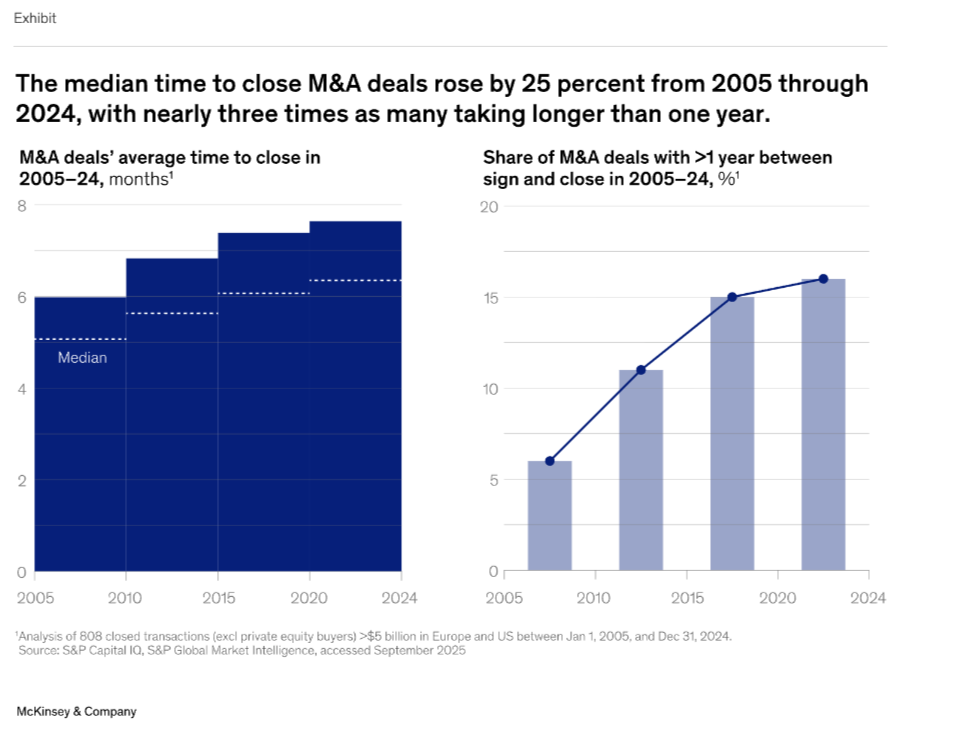
This is why companies rely on a due diligence data room checklist early in the process. It helps teams prepare and structure information across all key workstreams, reducing friction during review.
4 due diligence challenges addressed with the virtual data room checklist
Why is a checklist in a data room important? Successful dealmakers use data room checklists to address organizational and data management challenges. Based on our experience, a company should leverage an M&A data room checklist if it faces the following DD challenges.
| Due diligence challenges | Virtual data room value | Checklist value |
| 1. Unclear due diligence scope | Centralizes all due diligence materials in one structured environment with 24/7 access and consistent folder architecture | Ensures all required document categories are identified and included before the review starts |
| 2. Siloed teams and fragmented communication | Enables centralized collaboration through shared access, activity tracking, and integrated Q&A workflows. | Aligns cross-functional teams around a common due diligence framework and shared requirements |
| 3. Poor document organization | Improves document organization through data room index, metadata tagging, version control, and full-text search | Standardizes document collection, naming conventions, and folder structures across teams |
| 4. Security risks | Protects sensitive information with granular permissions, encryption, multi-factor authentication, and audit trails | Helps identify sensitive documents, define access levels, and support compliance requirements |
| Learn how to maximize due diligence organization with an effective data room structure. |
A VDR due diligence checklist and a virtual data room help companies prepare complete information, coordinate stakeholders, maintain security, and keep the due diligence phase on track.
Essential data room documents: the checklist
The exact contents of a due diligence data room depend on the transaction type, industry, and the target company’s maturity. However, most transactions require the same core categories of information. The VDR checklist below outlines essential data room documents commonly requested in M&A transactions, fundraising processes, and private equity investments.
| Category | Key documents to include |
| 1. Financial | Audited financial statements (3–5 years), management accounts, cash flow projections, cap table, budgets, debt schedules |
| 2. Commercial | Customer contracts, sales pipeline, pricing strategy, market analysis, competitor analysis, business plan |
| 3. Operations | Supplier agreements, operational processes, facilities information, inventory records, key dependencies |
| 4. IT and technology | IT infrastructure, software licenses, intellectual property documentation, cybersecurity policies, data protection documentation |
| 5. Tax | Tax returns, transfer pricing documentation, tax exposures, tax audits, compliance records |
| 6. Human resources | Organizational chart, employment agreements, compensation plans, benefits, HR policies |
| 7. Legal | Corporate formation documents, material contracts, litigation history, permits, regulatory filings |
Below, we break down each category of the data room checklist and outline the documents most frequently requested during due diligence.
1. Financial
Financial due diligence forms the basis of deal valuation. It helps buyers and potential investors verify historical performance, assess cash generation and liabilities, validate forecasts, and identify risks that could affect pricing, deal structure, and post-transaction value creation.
| Financial aspect | Documents |
| Financial statements and reports |
Equity capitalization table (cap table) |
|
Copies of unaudited financial statements |
|
|
Copies of audited financial statements (for at least the last three years) |
|
|
Pro forma statements for the next year |
|
|
Balance sheets |
|
|
Profit and loss statements |
|
|
Cash flow statements |
|
|
Accounts receivable and accounts payable reports |
|
|
Working capital reports |
|
|
Financial reporting controls |
|
| Financial metrics and projections |
Third-party financial evaluations |
|
Cash flow projections |
|
|
Budgets |
|
|
Revenue and operating expense projections |
|
|
Capital expenditure plans |
|
|
Key metrics and ratios: market, profitability, liquidity, solvency, efficiency |
|
|
Sensitivity analyses |
|
| Assets and investments |
Investment portfolio breakdown |
|
Historical documents on previous fundraising transactions |
|
|
Venture capital financings |
|
|
Fixed asset register |
|
|
Asset maintenance procedures and expenditures |
|
|
Asset management files |
|
|
Depreciation schedules |
|
|
Inventory valuation reports |
|
|
Inventory turnover ratios |
|
|
Property valuation reports |
|
| Debt and liabilities |
Debt schedule |
|
Contingent liabilities |
| Check an elaborated financial due diligence checklist for the most accurate deal valuations. |
2. Commercial
Commercial due diligence investigates the target company from a business perspective, determining its performance, market conditions, and competitive landscape. It is a crucial part of deal valuation and provides insights into the strategic fit of the entire transaction.
| Commercial aspect | Documents |
| Market |
Industry reports |
|
Target’s historical and projected performance against industry benchmarks |
|
|
Target’s market position |
|
|
Competitor analysis |
|
|
Pitch deck |
|
| Customers |
Past and current customer lists |
|
Customer satisfaction metrics |
|
|
Strategic partnership agreements |
|
|
Customer compliance records |
|
| Sales and marketing materials |
Target’s business plan |
|
Brand positioning and awareness metrics |
|
|
Sales strategies and marketing plans |
|
|
E-commerce strategies and online presence |
|
|
Target’s SWOT analysis |
|
|
Distribution channels |
|
|
Product lines |
|
|
A product roadmap |
|
|
Pricing strategies |
3. Operations
Operations represent the core value-generation engine of the business. As such, operational due diligence focuses on how effectively the company produces goods or delivers services, how resilient its operating model is, and how integration-ready it is for a post-acquisition environment.
| Operational aspect | Documents |
| Production |
Standard operating procedures and production workflows |
|
Quality control processes and reports |
|
|
Capacity utilization reports |
|
|
Equipment maintenance reports |
|
|
Operational risk assessment reports |
|
|
Environmental investigations |
|
| Supply chains |
Supplier lists |
|
Supplies metrics and performance reports |
|
|
Logistics and distribution performance records |
|
|
Inventory management reports |
|
| Health and Safety |
Workplace health and safety policies and procedures |
|
Incident reports |
|
|
Emergency response plans |
4. IT technology
Technology due diligence assesses IT architecture, integration dependencies, scalability, operational resilience, and cybersecurity risks. It also identifies opportunities for value creation through system consolidation, automation, and digital transformation within the post-merger integration (PMI) plan.
| Technology aspect | Documents |
| Infrastructure |
Hardware and server inventory reports |
|
Network architecture documentation |
|
|
Cloud service usage reports |
|
| Software applications |
Lists of software applications and licenses |
|
Software usage reports |
|
|
Software update policies |
|
|
Software documentation packages |
|
| Cybersecurity |
Cybersecurity policies and procedures. |
|
Security controls |
|
|
Incident response plans |
|
|
Third-party cybersecurity audits |
|
|
Penetration testing reports |
|
|
Incident reports |
|
|
Disaster recovery plans and testing records |
|
| Data privacy and protection |
Privacy policies |
|
Data protection policies and practices |
|
|
Data incident reports |
|
| Technology integration |
Technology integration roadmaps |
|
Integration risk reports |
|
|
Service documentation |
5. Tax
Tax due diligence assesses historical tax compliance, current tax positions, and potential future tax exposures that may affect deal valuation or create liabilities during post-merger integration (PMI). It also identifies areas of tax risk, including uncertain tax positions, cross-border obligations, and potential disputes with tax authorities.
| Tax aspect | Documents |
| Tax policies |
Information on tax policies |
|
Transfer pricing documentation |
|
| Tax compliance |
Tax returns for the last two years |
|
List of jurisdictions where a target company pays taxes and files tax returns |
|
|
Internal tax compliance controls and procedures |
|
|
Schedule of upcoming tax compliance filings |
|
| Tax audits |
Schedule of completed tax audits for the last five years |
|
Tax authority correspondence |
|
|
Records of tax disputes |
|
| Tax reserves and liabilities |
Tax reserves on the balance sheet |
|
Contingent tax liabilities |
|
|
Tax exposure provisions |
6. Human resources
Human resources due diligence investigates the organization’s workforce structure, key personnel dependencies, compensation frameworks, and employment obligations. It examines the stability of leadership, the availability of critical talent, and potential risks related to retention, culture alignment, and workforce integration.
| HR aspect | Documents |
| Workforce composition |
Organizational charts and reporting channels |
|
Employee demographics reports |
|
|
Key employee resumes |
|
|
Turnover reports |
|
|
Employee complaint records |
|
| Employee benefits and policies |
Benefits policies |
|
Policies regarding sick days, overtime, and paid holidays |
|
|
Appraisal policies |
|
|
Insurance policies |
|
|
Retirement plans and pension documentation |
|
|
Employee handbooks |
|
| Training and development |
Details about training programs |
|
Professional development plans and opportunities |
|
|
Employee certifications |
|
|
Leadership succession planning programs |
|
| Compensation |
Employee compensation structures |
|
Incentive plans |
|
|
Payroll records |
|
| Corporate culture and employee relations |
Corporate value and belief summaries |
|
Leadership practice summaries |
|
|
Decision-making approach analyses |
|
|
Employee satisfaction reports |
|
|
Employee engagement initiatives |
|
|
Corporate culture assessments |
|
|
Stakeholder communication reports |
|
| Labor union |
Labor union negotiations and relationship history |
|
Related disputes and resolutions |
7. Legal
Legal due diligence examines all the legal documents of the business to identify risks that could affect transaction execution, valuation, or post-merger integration (PMI). It focuses on how the company is structured, how it operates within applicable legal and regulatory frameworks, and whether its contractual and governance arrangements create current or future liabilities.
| Legal aspect | Documents |
| General information |
Articles of incorporation and bylaws |
|
Organizational chart showing the corporate structure, including all the subsidiaries |
|
|
Records of board meetings |
|
|
List of jurisdictions where a target company is licensed |
|
| Financial |
Loan agreements |
|
Shareholder agreements |
|
|
Purchase agreements relating to the past, current, and future mergers and acquisitions rounds |
|
|
Equity and debt insurance |
|
|
Notable material contracts |
|
|
Guarantees and indemnities |
|
|
Warranties and representations |
|
| Commercial |
Vendor agreements |
|
Distributor agreements |
|
|
Licensing agreements |
|
|
Sales and marketing contracts |
|
|
Franchise agreements |
|
|
Joint venture agreements |
|
| Operations |
Equipment and property leases |
|
Manufacturing agreements |
|
|
Service level agreements (SLAs) |
|
|
Insurance policies |
|
|
Research and development agreements |
|
| IT technology |
Escrow agreements |
|
Technology transfer agreements |
|
| Human resources |
Employment agreements and contracts |
|
NDAs and NSAs |
|
| Compliance |
Information about certifications and compliance a target company corresponds to |
|
Tax regulation compliance records |
|
|
ESG compliance reports |
|
|
Data security and privacy compliance certificates |
|
|
Antitrust filings |
|
|
Regulatory approvals and permits |
|
|
Open source software compliance verification records |
|
| Intellectual property (IP) |
Schedule of owned proprietary technology (software, systems, and databases) |
|
Trademarks, brand names, slogans, logos, etc. |
|
|
Copyrights |
|
|
Domain names |
|
|
IP licensing agreements |
|
|
IP registration records |
|
|
IP-related contracts |
|
|
IP valuation reports |
|
|
IP security agreements |
|
| Disputes and litigations |
Legal disputes |
|
Intellectual property infringements |
|
|
Past, current, and pending insurance disputes |
|
|
History of legal settlements |
👁️🗨️Additional insights: 9 Due Diligence Mistakes That Kill M&A Deals (2026) | Acquisition Stars
What to include in a data room by deal type
Data room requirements vary by transaction type. Core categories remain similar, but the focus shifts depending on the deal objective. A well-structured data room should reflect these differences.
| Deal type | Focus | Must-have documents |
| 1. M&A | Full company review for a buyer | Corporate, financials, commercial, HR, legal, tax |
| 2. Startup/investor fundraising | Growth and traction | Pitch deck, cap table, financials, metrics, team, go-to-market (GTM) strategy |
| 3. Private equity | Returns and value creation | Financial model, QoE, debt, management, market |
| 4. Industry-specific | Sector compliance and assets | Licences/permits, regulatory filings, asset or IP documentation |
1. M&A data room
M&A data rooms support a full-scale review of the target business from a buyer’s perspective. The focus is on validating valuation assumptions, identifying risks, and assessing post-acquisition integration.
M&A data room checklist:
- Corporate records
- Financial statements and management reports
- Commercial and operational materials
- HR and employment information
- Legal contracts and obligations
- Tax documents
2. Startup/investor fundraising data room
Startup data rooms are designed to communicate traction, growth potential, and investment readiness. The focus is on demonstrating product-market fit, scalability, and key performance indicators that support future valuation.
Data room for investors checklist:
- Pitch deck
- Cap table
- Financial projections and burn data
- Key metrics and KPIs
- Team overview
- Go-to-market strategy
3. Private equity fund data room
Private equity data rooms focus on evaluating financial performance, downside risk, and value creation potential. The emphasis is on detailed financial analysis, operational efficiency, and return drivers.
PE fund data room checklist:
- Financial model
- Quality of earnings (QoE)
- Debt and capital structure information
- Management reporting packs
- Market and competitive analysis
- Value creation plan
4. Industry-specific data rooms
Industry-specific data rooms reflect the regulatory, technical, and asset-specific requirements of a given sector. The focus is on compliance with relevant regulations, operational constraints, and risks that materially affect valuation and deal feasibility.
Industry-specific data room checklist:
- Licences and permits
- Regulatory filings
- Asset, reserve, or IP documentation (depending on sector)
- Compliance and technical reports
Aligning data room content to deal type ensures that investors and acquirers receive the right level of information to assess risk, validate assumptions, and make informed decisions efficiently.
Data room security and best practices
A secure data room is essential for protecting sensitive information during due diligence and ensuring that access to important documents is properly controlled and fully traceable. Strong security measures reduce the risk of data leaks, support compliance requirements, and increase investor confidence.
Here are the core security features of a data room used in due diligence:
- Granular permissions restrict access to specific folders and documents, allowing administrators to control exactly what each user can view, download, or edit.
- Multi-factor authentication (MFA) and single sign-on (SSO) verify user identity and prevent unauthorized logins.
- Encryption protects data both in transit and at rest, ensuring that outside parties cannot intercept or read files.
- Dynamic watermarks add visible identifiers to documents and discourage unauthorized sharing or leaks.
- Audit logs record all user activity and show who accessed, viewed, and downloaded each file.
- Activity tracking provides real-time visibility into user behavior and helps identify unusual or risky actions.
- Q&A tools structure communication between parties and keep all due diligence questions and responses documented within the deal workflow.
A secure data room for due diligence protects sensitive transaction data, controls user access, and ensures full transparency of all activity throughout the deal process.
Check the top solutions in our best data room providers comparison for secure and efficient due diligence.
Case study: Ideals + StoneX Group Inc
StoneX, a century-old financial services franchise with over 300 OTC products and over $4.4 trillion in traded volume, has used Ideals virtual data room for DD and M&A since 2018.
Industry: Financial services, commercial hedging, global payments.
Pre-VDR challenges:
- StoneX experienced security challenges using traditional file-sharing solutions.
- StoneX’s DD workflows lacked document organization.
- The company required prompt information exchange and activity tracking.
VDR impact:
- Secure data storage and confidential document handling protected StoneX’s workflows.
- Bulk document actions, document labels, optical character recognition (OCR) search, and automatic indexing helped StoneX organize due diligence materials across several projects.
- Collaborating with bidders on separate projects helped the company retain workflow independence and reduce communication breakdowns. It improved overall deal-room efficiency across all 34 StoneX projects.
VDR checklist impact: Developing, exchanging, and tracking DD checklists enabled StoneX’s DD teams to review more documents, uncover hidden issues, and improve transaction risk management.
Key takeaways
- A well-organized data room provides a secure online platform for managing, storing, and sharing transaction information
- A structured checklist ensures consistent coverage of all key business areas and reduces the risk of missing material information during review
- Financial, commercial, operational, legal, tax, HR, and technology due diligence form the foundation of a complete data room framework
- Data room requirements vary by deal type, and content should adapt to M&A transactions, startup fundraising, private equity investments, and industry-specific reviews
- Security features such as granular permissions, encryption, audit logs, and structured Q&A ensure controlled and traceable access to sensitive data
- A well-designed data room improves efficiency, reduces transaction risk, and supports faster, more informed decision-making
Category
Data roomsFAQ
A due diligence data room is a secure platform for storing, organizing, and sharing confidential business documents during business transactions. It allows authorized parties to access information in a controlled environment with permissions, tracking, and version control.
A data room should include all key business information needed for review, typically covering financial, commercial, operational, legal, tax, HR, and technology areas. The exact content depends on the transaction type, industry, and the company's stage.
An investor data room checklist typically includes materials that demonstrate business performance and growth potential, such as a pitch deck, cap table, financial projections, key metrics, team information, and a go-to-market strategy.
A virtual data room due diligence is structured into clearly defined folders that reflect core business functions, such as financials, commercial, operations, legal, tax, HR, and technology. This structure helps users locate information quickly and ensures consistent document organization across the review process.
A data room is the platform where companies store and share documents. A VDR checklist is a comprehensive list of documents that need to be prepared and uploaded. The checklist guides preparation. The data room enables secure execution of the due diligence process.
There is no fixed number of documents in a typical M&A data room, as it depends on the size and complexity of the business. However, larger financial transactions can involve hundreds or even thousands of documents across all functional areas, including financial, legal, commercial, and operational records.
A data room is important in the due diligence process because it provides a secure, centralized environment for storing, organizing, and sharing sensitive business information. It improves efficiency by giving stakeholders controlled access to documents, streamlining communication, and reducing delays caused by fragmented information.